
THE KNEELING CHAIR POSTURE SHIFT
What if better posture started with how you sit?


ErgonomicLux
Ergonomic Kneeling Chair Stool for Back Relief & Posture Support
Ergonomic Kneeling Chair Stool for Back Relief & Posture Support


Couldn't load pickup availability


This is your spine at 3pm.

This is your spine all day.

The kneeling chair does not fix your posture. It makes bad posture impossible.
By tilting your pelvis forward and opening your hip angle to 110 degrees, your spine stacks naturally. No reminders. No back braces. No willpower required.
How a Simple Angle Change Transforms Your Spine


The Open Hip Angle
A standard chair locks your hips at 90°, tightening hip flexors and forcing a slouch. The kneeling chair opens that angle to 110°, rotating the pelvis forward so your spine sits upright naturally.


Natural Spinal Alignment
When the pelvis tilts forward, your spine returns to its natural S-curve without effort. Lower back regains its arch, shoulders draw back, head centers over the body. No more reminding yourself to sit up straight.


Passive Core Activation
Traditional chairs switch your core off. The kneeling position encourages light, sustained engagement of deep spinal stabilizers throughout the day. Not a workout, just your body doing what it's designed to do.
What People Are Saying After Switching
Honest accounts from people who made the switch and never looked back.
Every Detail Designed to Support You
We obsessed over the three elements that separate a chair you abandon in a week from one that transforms your workday permanently.

Side-Screw Height Adjustment
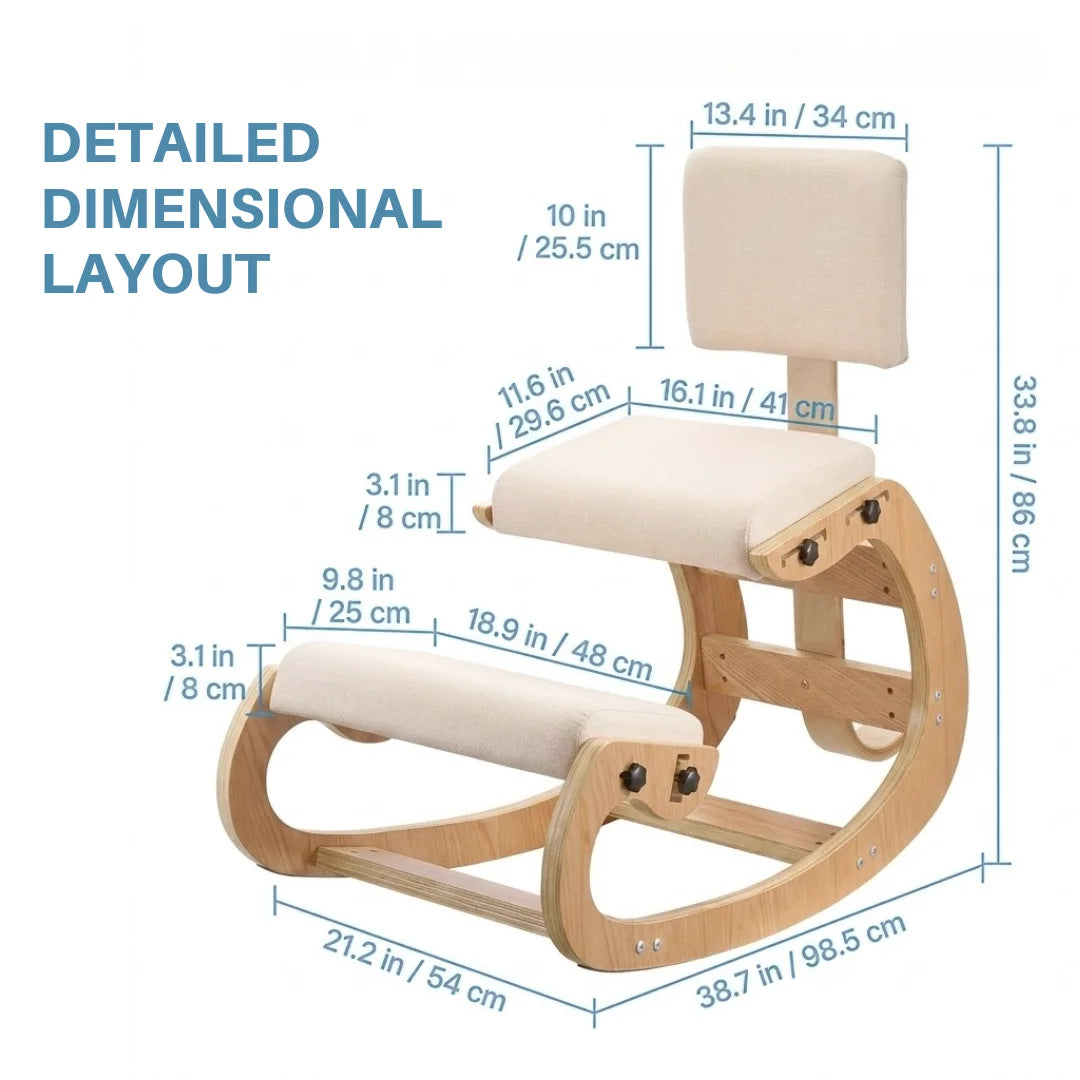
Not every desk or body is the same. The dual side-screw adjustment lets you set the seat height in seconds for a better fit and natural posture. Just twist, adjust, and lock, no tools needed after assembly.

Enlarged High-Density Foam Cushions
Most kneeling chairs get this wrong. We enlarged the seat and knee pads and used high-density foam for lasting support and better pressure distribution so your shins and sit bones stay comfortable all day without bottoming out.

Sturdy Frame with Floor-Safe Glides
A wobbly chair kills focus. Our powder-coated steel frame stays solid as you shift and lean, while non-scratch glides protect floors and keep it planted no rolling, no drifting.
Your Adaptation Journey
Yes, There Is a Learning Curve. That Means It Is Working.
Any chair that genuinely corrects your posture will feel new at first. Here is what to expect, week by week.

Getting Acquainted
If you are used to slouching, the kneeling chair may feel different at first, that is normal. It opens your hip angle and supports better posture.
Pro tip: Set a timer. Short, frequent sessions build the right muscles without fatigue.

Building Tolerance
Your core starts engaging more, so mild soreness in the lower back and hips can happen, that is normal muscle activation, not injury.
Keep going: The soreness peaks around day 5 then fades fast. Most people push through and never look back.

The Shift Happens
This is when the shift happens, sitting feels more natural, posture comes easier, and back discomfort may start to ease through your workday.
This is the turning point. People who make it to week 2 almost never go back to a conventional chair.

The New Normal
By week three, the kneeling chair feels natural. Posture becomes automatic, neck and shoulder tension may ease, and you sit taller without trying.
Long game wins: Users report continued improvement through months 2 and 3 as deep postural muscles strengthen.
What You Are Really Paying
for Back Pain Relief
Most people spend thousands trying to fix the symptoms. The kneeling chair addresses the root cause for a fraction of the cost.


No subscriptions. No appointments. No bulky furniture to rearrange. Just a scientifically sound sitting position that trains your spine to align itself, every single day you sit down to work.
A kneeling chair isn't the cost, it's the end of paying for temporary relief.
Ready in Minutes, Comfortable for Years
No confusing instructions, no special tools. Three steps between unboxing and your first pain-free sitting session.
Set the Optimal Seat Height
Use the star knob under the seat to raise or lower it until your hips feel open and comfortable. This forward tilt is what unlocks the posture benefits.
You have found the right height when your thighs slope gently downward and sitting upright feels natural.

Fine-Tune the Knee Pad Position
Use the star knobs on the knee pad frame to adjust the angle and distance so your shins rest comfortably with proper support.
The enlarged high-density foam cushions distribute weight across the shins instead of concentrating pressure. A minute of dialing in makes it feel custom-fit.

Experience Active Sitting
Once seated with your shins on the knee pad, the chair naturally leans forward on its curved rockers, creating gentle movement instead of locking you in one position.
Start with 20 to 30 minute sessions and alternate with your regular chair. Most people increase their time naturally within the first week.

Your Purchase, Protected
Real guarantees, not fine print.
30-Day Comfort Guarantee
Free Shipping
Easy Assembly
Fast Support
30-Day Comfort Guarantee
Free Shipping
Easy Assembly
Fast Support
Everything You Need to Know
Honest answers to the questions we hear most, so you can make your decision with total confidence.
1 Will this hurt my knees?
This is the number one concern, and the answer is no. A kneeling chair does not place your body weight on your knees. Your shins rest against the lower cushion, but roughly 80% of your weight stays on the seat cushion through your hips, just like a regular chair. The knee pad simply prevents you from sliding forward.
The enlarged high-density foam cushions on this model are specifically designed to distribute pressure evenly across your shins. Most users compare the sensation to resting your legs on a firm pillow. If you have a pre-existing knee injury or recently had knee surgery, we recommend checking with your doctor first.
2 What is the weight capacity?
The Ergonomic Adjustable Posture Kneeling Chair is built on a sturdy steel frame engineered to support up to 250 lbs (113 kg) comfortably. The welded joints and reinforced cross-members provide stability without any wobble, even during slight rocking or repositioning throughout the day.
The non-scratch floor glides further anchor the chair and keep it grounded on any surface. If you are close to or above the weight limit, the chair will still function, but you may experience faster cushion compression over time. For the best long-term experience, we recommend staying within the rated capacity.
3 Can I use this on carpet or hardwood floors?
Yes, it works beautifully on both. The chair comes with non-scratch floor glides on the base, which protect hardwood, tile, laminate, and vinyl floors from scuffs and marks. On these hard surfaces, the glides provide a slight grip that keeps the chair from sliding around while you sit.
On carpet, the flat glide design sits flush against the surface and provides stable, level support. Thicker pile carpets may cause slightly more resistance when repositioning, but the chair remains perfectly functional. Many users place a simple desk mat underneath for the smoothest experience on deep carpet, though it is not required.
4 How long does it take to adjust to a kneeling chair?
Most people need about 1 to 3 weeks to fully transition. During the first few days, you may notice muscles in your core and lower back engaging in ways they have not in years. This is a good sign. It means the chair is working, and those stabilizer muscles are waking up.
We recommend starting with 20 to 30 minute sessions and alternating with your regular chair. By week two, most users naturally extend their sessions to several hours. By week three or four, the kneeling chair typically becomes your preferred seat, and going back to a standard chair starts to feel uncomfortable.
5 Is this suitable for tall or short people?
Yes. The side-screw height adjustment mechanism allows you to raise or lower the seat to match your body proportions and desk height. This makes the chair comfortable for users ranging from approximately 5 feet 0 inches to 6 feet 2 inches tall. The adjustment is smooth, tool-free, and can be changed in seconds.
If you are on the shorter side, you will likely position the seat lower so your thighs angle downward comfortably. Taller users raise the seat higher and may appreciate pairing the chair with a slightly taller desk. The key measurement is that your thighs should slope gently downward when seated, creating that open hip angle that makes the chair so effective for your spine.
6 Can I use this without a desk?
Technically yes, but it works best paired with a desk or work surface. The kneeling position naturally tilts your body slightly forward, which is ideal when you have a desk, keyboard, or workstation in front of you. The desk gives your arms a natural resting place and completes the ergonomic posture chain.
Some users do enjoy using it for activities like playing guitar, drawing, meditation, or reading, where a surface is not needed. In these cases, the upright posture and core engagement still provide benefits. However, for extended sessions of several hours, having a desk in front of you provides the most balanced, comfortable experience.
7 What if it does not work for me?
We offer a 30-Day Comfort Guarantee. If you use the chair and genuinely feel it is not improving your comfort or posture within 30 days, you can return it. No complicated forms, no interrogation. We believe in this product because the biomechanics are sound, and the vast majority of users report significant improvement.
That said, we do encourage giving yourself the full adjustment period before deciding. Many people who felt unsure in the first week became our biggest advocates by week three. Your body needs time to rebuild the postural muscles that years of slouching have weakened. But if after a fair trial it is not right for you, the guarantee has you covered.
8 How does the height adjustment work?
The chair uses a simple side-screw adjustment system. Two knobs located on either side of the frame allow you to loosen, raise or lower the seat height, and then lock it in place by tightening. No tools are needed after initial assembly, and the adjustment takes about 10 seconds.
This is intentionally a manual system rather than a gas lift cylinder. The advantage is that once you set your height, it stays locked with zero drift or sinking over time. Gas lifts in traditional chairs often lose pressure and slowly drop, which is why you find yourself pumping the lever throughout the day. With the screw-lock mechanism, you set it once and it holds firm for months until you choose to change it.